
Self-Confidence: The Alliance Between Introspection and Action – Article
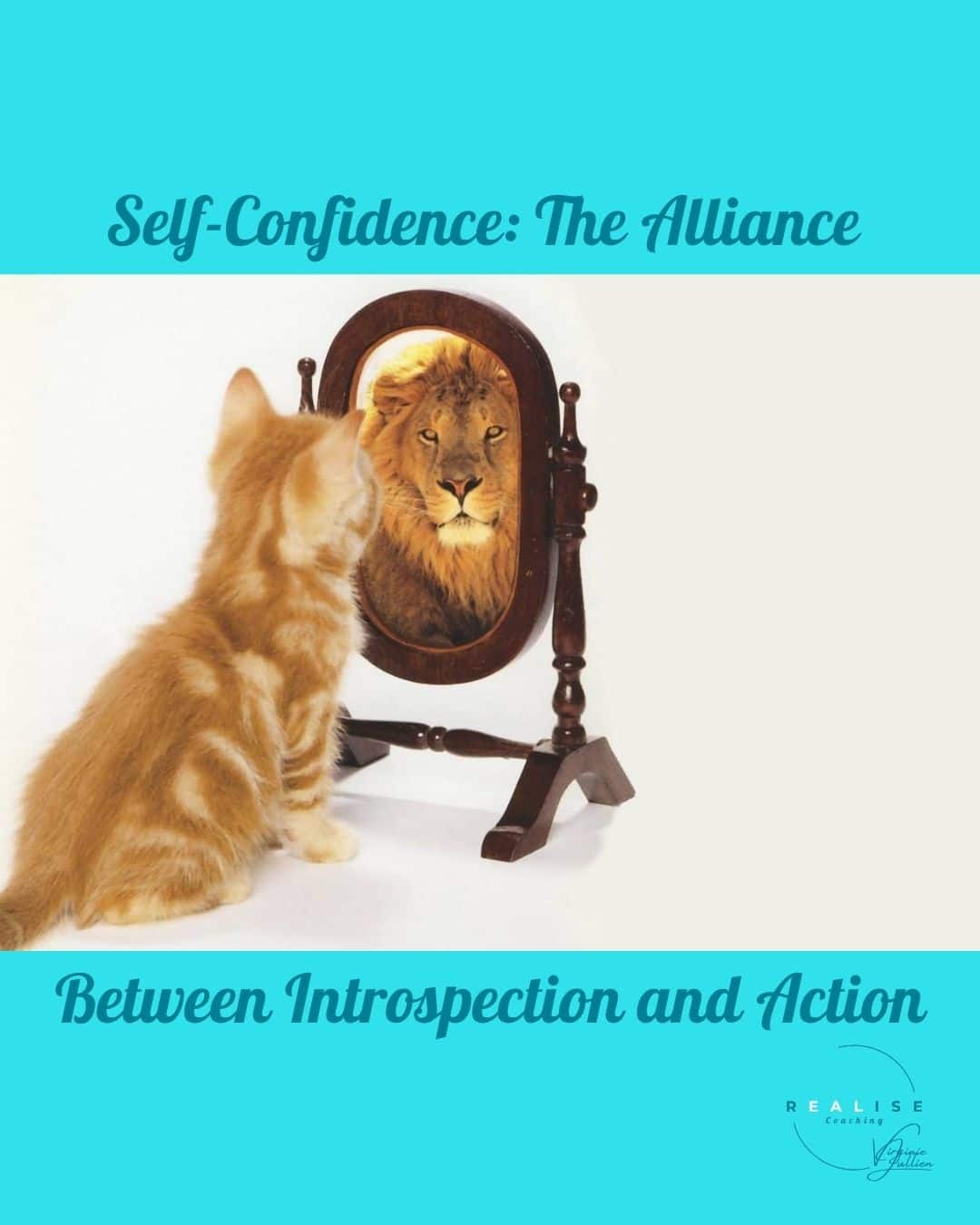
Self-Confidence
During a seminar dedicated to self-confidence, Frédéric Lenoir and Christophe André—two people who deeply inspire me—shared their vision of this universal yet intimate concept.
As I listened to them, I realised how closely I shared their perspective: there can be no real confidence without a solid understanding of oneself.
This is exactly what I observe every day in my coaching sessions: as long as we don’t acknowledge our strengths and weaknesses, it’s difficult to trust ourselves.
So I wanted to share in an article what resonated most strongly with me during this seminar, and how these reflections align with my coaching practice.
What Do Frédéric Lenoir and Christophe André Tell Us About Self-Confidence?
Self-confidence is a mental capacity that we draw upon when facing difficulties, uncertainty, and everyday challenges. It is inseparable from self-knowledge.
Confidence comes from our assessment of the balance between the difficulty of a situation and the resources we believe we have to face it. Of course, this evaluation can be distorted by our emotions, stress, or self-perception.
Frédéric Lenoir and Christophe André define it as the feeling that “things are going to be okay,” without any guarantee.
Self-confidence is not a permanent state—it fluctuates depending on the context. We may feel very confident for a job interview, yet much less so when speaking in public.
But lasting confidence relies on an inner posture: “I’m doing my best, and we’ll see.”
It’s the art of separating the process from the result.
Know Yourself
A lack of self-confidence often stems from bias in our self-knowledge: we look mostly at what isn’t working.
Our mistakes, our shortcomings, our failures…
If I asked my clients to list everything they can’t do, the list would be long. It’s an exercise I never ask of them—because they’re already experts at it!
But when I ask them to name everything they can do, the reaction is completely different: smiles freeze, eyes glaze over, they feel lost and don’t know where to begin.
And yet, this exercise is fundamental: how can we develop self-confidence if we don’t even realize what we’re capable of?
Between Introspection and Action
Socrates said: “Know thyself.”
And in this phrase lie two dimensions:
-
introspection—reflecting on oneself, and
-
action—experimenting.
It’s the alliance of both that builds true confidence.
Action allows us to interact with the world and receive feedback—often much kinder than our own internal voice. Self-confidence then becomes a blend of our inner judgment (often critical) and the positive perspective of others.
Note that self-confidence relates to action and skills (DOING), while self-esteem relates to who we are (BEING). Naturally, the two influence one another.
Learning to Fail
A person who is confident is tolerant of failure, discomfort, and difficulty.
They know that “not knowing” is normal, and that “messing up” is part of learning.
👉 We must train ourselves to fail, and accept failure as a field of experimentation.
What I notice in my sessions is that when we haven’t learned how to fail, the very idea of failure becomes paralyzing.
This is a real challenge for those who have always succeeded—often without much effort—or for perfectionists.
When they fail, everything shakes: identity, personal worth, confidence.
There’s no notion of progression: either they know or they don’t, and they confuse identity with competence.
Learning to be wrong—even to fall flat on your face—is a crucial step toward building solid and lasting confidence.
Failure then becomes a learning experience, not a judgment of who we are.
Embracing All Our Parts
Carl Gustav Jung reminds us that the journey toward oneself consists of integrating all our parts, both light and shadow.
He called this the process of individuation: accepting that we are unique, singular, imperfect beings.
It is by letting go of the need to be perfect that we uncover our full capacities.
And above all, without comparing ourselves.
Seneca said: “If you want to be unhappy, compare yourself.”
Comparison is destructive—I can’t repeat it enough.
We compare and judge ourselves… but based on what?
Often, we don’t even know ourselves well, let alone the person we’re comparing ourselves to.
It’s like comparing apples and pears—and it leads only to devaluation.
To compare yourself is to forget that each person moves along their own path, at their own pace, with their own resources.
Daring to Be Vulnerable
Having self-confidence also means daring to show your weaknesses.
And realizing that 95% of people don’t care… or find it endearing.
Only 5% judge—and that’s their business, not ours.
We’re often perceived as more “likable” when we show our vulnerabilities, because authenticity is appealing.
Rediscovering What Brings Us Joy
Spinoza invites us to observe what brings us joy.
Positive emotions signal that we are moving in the right direction, while negative emotions indicate that we’re drifting away from it.
When a client tells me she doesn’t know what she loves doing, I always invite her to explore what gives her energy, what sparks joy, what excites her in a positive way.
These clues are reliable compasses: they reveal what we truly love doing—or being.
Regaining self-confidence also means reconnecting with that vibration.
Where there is joy, there is meaning and desire!
Learning to Let Go
Having confidence means being okay with not knowing everything.
It means distinguishing between what is within our control and what is not.
I often ask this question in coaching: how much time and energy do we waste trying to solve what lies outside our control?
Our brain desperately wants to find a solution, so it loops.
Result: we ruminate, we stress, we exhaust ourselves.
It becomes essential to return to our zone of control—what we can act on—and to accept what we cannot influence.
Accepting what is does not mean giving up or becoming passive.
It means choosing to free ourselves from a useless struggle and shifting our mindset toward the situation.
This acceptance, this letting go, is also an act of trusting life.
The Impact of Patriarchy
During this seminar—led by six male speakers—Christophe André highlighted a crucial point:
“Our society prepares men to be more confident than women…”
This sentence resonates deeply and reveals how strongly we are still shaped by this social construction, often unconsciously.
The impact of patriarchy on our lives and careers as women is an entire chapter of my book Pandore a raison.
Women’s lack of self-confidence is not an individual weakness: it has been built over centuries.
Becoming aware of this helps us see that there is nothing “wrong” with us—it’s a collective dynamic that explains women’s confidence gap.
This realization is liberating.
From there, it becomes easier to rebuild self-confidence, because confidence can be learned, nurtured, and built.
And it starts with one simple thing: daring to take action.
Do You Want to Dare Taking Action but Don’t Know Where to Start?
I offer a free discovery session to help you identify your resources, your obstacles, and the first steps to take to (re)build your self-confidence.
➡️ Book your free discovery session here.
What I Thought of the Seminar
Frédéric Lenoir and Christophe André are two people who deeply inspire me.
I even referred to Christophe André’s work in Pandore a raison to dismantle the “fear box.”
And yet, as I left the seminar, I felt both joy and frustration.
Joy, because these reflections deeply resonate with what I already share through my coaching, my talks, and my book. 🤩
Frustration, because I am not yet invited to speak about self-confidence at a major seminar gathering thousands of people! 😅
Is it my ego speaking or my insatiable desire to share? Maybe a bit of both…
But one thing I know for sure: nothing makes me happier than my role as an author and speaker, sharing my vision of personal development and the world with an ever-growing audience. 🌟
Want to Receive New Articles Directly in Your Inbox?
✨ If you enjoyed this article and would like to receive my next writings and inspirations directly in your inbox, sign up for my newsletter:


Recent Comments